DRAGONFLY JOURNAL
Group Mindfulness Activities for Retreats and Teams
Group Mindfulness Activities for Retreats and Teams

The best group mindfulness activities are short, simple and easy to lead: guided breathing, mindful walking, a brief body scan, a sensory pause, a gratitude round, silent reflection and a quick check-in. You do not need special training or equipment to offer them to a friendly group. You do need a calm space, a clear plan and the willingness to change that plan when the room tells you to. This guide covers ten activities, how to adapt them, a sample session plan and a sample retreat day.
We host groups at The Dragonfly Retreat, a private venue in the Andalusian countryside near Coín, Málaga, so the examples lean towards retreats and team days. Everything here works equally well in a village hall or a meeting room.
TL;DR
- Start with short practices of 2 to 10 minutes: breathing, a sensory pause, a check-in. Build up only if the group wants more.
- Always offer choices (eyes open or closed, sitting, standing or walking) so beginners and sceptics feel at ease.
- A good session has an arrival, one or two practices, a moment to share and a quiet close, usually 45 to 90 minutes in all.
- Mindfulness is a way to pause together. It is not a treatment, and nobody should be pushed to take part.
- Space matters: quiet, comfortable and varied. Outdoor and indoor areas let you move the session as the weather and mood change.
Table of Contents
- What makes a group mindfulness activity work
- Ten simple activities to lead with a group
- Adapting activities to your group
- A simple session plan you can copy
- What a mindful retreat day might look like
- Choosing a setting that supports quiet
- Hosting a group retreat at The Dragonfly
- FAQ
- Sources
What makes a group mindfulness activity work
Mindfulness, in plain terms, is paying attention to the present moment on purpose. The NHS describes it as noticing your surroundings, your body and your thoughts, with simple techniques such as taking a minute to look around and notice the shape, colour and texture of what is near you. That small, ordinary instruction is the template for most group exercises.
In a group, three things decide whether an activity lands:
- Low pressure. Nobody should have to perform, share or close their eyes.
- Clear, short instructions. Say what you will do, for how long, and what people can do if it is not for them.
- A gentle voice and unhurried pace. Leave more silence than feels natural. It is usually what people remember.
A facilitator is there to hold the space, not to be the expert in the room. Plum Village UK, which supports community mindfulness groups, describes the facilitator’s job as coordinating the stages of a session and creating a space that supports practice, rather than acting as a teacher. It also suggests two people facilitate together where possible, which is a useful habit for a retreat leader or a team lead who would like to take part too.
Ten simple activities to lead with a group
These are listed roughly from easiest to most reflective. Times are a guide.
1. Guided breathing (3 to 5 minutes)
Invite people to sit comfortably, feet on the floor, and notice the breath without changing it. After a minute, you can offer a gentle rhythm, such as breathing in for four counts and out for four. Some facilitators use a visual to pace the group, such as a slowly expanding shape on a screen, as in the box-breathing and group breath-pacing ideas in Thrive’s list of 15 group activities. Outdoors, a slow hand rising and falling does the same job.
Say that anyone who finds counting uncomfortable can simply follow the natural breath.
2. Mindful walking (10 to 20 minutes)
Walking is often the best entry point for people who find sitting still hard. Ask the group to walk slowly, in silence, noticing the feeling of each foot touching the ground. A loop of 20 to 30 paces is enough. Some people prefer to wander through a garden at their own pace and return when they hear a bell or a soft clap.
Walking meditation appears in both Thrive’s list and the practices Plum Village describes for its groups, so it is a well-established format. Keep the instructions to three sentences.
3. A short body scan (3 to 10 minutes)
Guide attention slowly from the feet to the head, pausing briefly on each area: feet, legs, hips, back, hands, shoulders, face. The aim is simply to notice, not to relax on demand. Thrive includes a three-minute version, which suits corporate groups and first-timers.
Offer it seated as well as lying down. Some people find lying down with eyes closed uncomfortable in front of colleagues, and that is entirely reasonable.
4. Five-senses check-in (3 to 5 minutes)
Ask everyone to notice five things they can see, four they can touch, three they can hear, two they can smell and one they can taste. It is a quick grounding exercise that works in a meeting room, on a terrace or in a minibus. The five-four-three-two-one pattern is one of the activities in the Thrive list.
5. Sound mapping (5 minutes)
Sit in silence and listen. Afterwards, ask people to name the sounds they noticed, near and far: birdsong, a distant dog, a breeze through leaves, a chair creaking. This is one of the gentlest activities for people who think they “cannot meditate”, because there is nothing to get right. It is especially pleasant outdoors in a quiet rural setting.
6. Mindful eating (15 to 30 minutes)
The raisin exercise is the classic: hold a single raisin, look at it, smell it, then eat it slowly. A Church of England diocese resource describes a longer version in which people take an apple and eat it mindfully in pairs or threes, in a space where each person has room and is not overly aware of the others. Fruit, a square of chocolate or a slice of orange all work. Check for allergies first, and always offer an alternative.

7. Listening in pairs (10 minutes)
One person speaks for two minutes about anything, such as a favourite place or what they hope for from the day. The other listens without interrupting, then they swap. Pairs feel safer than a full circle, and they warm a group up before any whole-group sharing. It is also a good way to help a team who rarely talk to each other.
8. Gratitude round (5 to 10 minutes)
Ask each person to name one small thing from the day they appreciated: a coffee, the light on the hills, a kind word. Keep it brief, one sentence each, and allow people to pass. Constraining the format stops it becoming sentimental or long-winded, and it makes a neat close to a session.
9. Silent reflection with a prompt (10 to 15 minutes)
Offer one open question, such as “What do I want to leave behind today?”, then sit quietly with a notebook or without one. Some groups like to draw instead of write. Silence is the activity, so resist the urge to fill it.
10. Short group check-in (5 to 10 minutes)
Go around the circle and ask for a word or short phrase describing how each person is arriving. No comments, no fixing. It tells you the mood of the room and makes it easier to pitch the rest of the session. A matching check-out at the end shows how things have shifted.
Adapting activities to your group
No session plan survives contact with real people, and that is fine. The Bangor University manual for assessing mindfulness teaching says a teacher should hold a session plan flexibly and lightly, responding to the moment and tailoring the pace to participants. The same is true for a team away day.
By group size
| Group size | What works well | What to change |
|---|---|---|
| 2 to 6 | Open circle discussion, shared silence, walking together | Sharing rounds can run long, so keep them to a sentence |
| 7 to 15 | Pairs then circle, check-ins, mindful eating in small clusters | Use pairs or threes to give everyone airtime |
| 16 or more | Guided practices led from the front, sound mapping, group breathing | Share in small groups, take only a few reflections to the whole room |
Large groups need more space between people, so that each person has a sense of privacy. Spread out across a garden or a terrace if you have the room.
By experience level
For complete beginners, keep every practice under five minutes, explain what is going to happen before it begins and avoid jargon. Many people arrive worried they will be “bad at it”, so say plainly that a wandering mind is normal and noticing it is the practice.
For groups with experience, extend the silences, drop the commentary and let people choose their own posture and practice. Silent walking, longer sits and a quiet meal work well.

For mixed groups, give a base activity with optional extras: “If you would like to, close your eyes. If not, rest your gaze on the floor.” The University of Maryland Extension’s educator’s guide to mindfulness activities for adults is built around the same idea: adjust the surroundings, length, posture and script to suit the people in front of you.
By energy level
- Low energy (after travel, late afternoon): short, seated, gentle. Sound mapping, a five-senses check-in, a few slow breaths.
- High energy or restless: begin with walking or stretching, then move to something still. Do not demand stillness first.
- Tired from a full day of workshops: one short practice and an early finish is better than a long one.
Watch the room rather than the clock. If people are fidgeting, shorten the practice. If they seem settled, let the silence run.
Making space for everyone
Mindfulness suits many people, but not at every moment. The NHS East London Foundation Trust’s implementation resources for mindfulness-based cognitive therapy note that not everyone benefits from a mindfulness course at any time, and that for some, including people with early trauma, it may not be right. For that reason, keep casual group sessions light, make every part optional, and let people open their eyes, leave the room or sit out without explanation. If a member of your group has a mental health condition, they should feel free to check with their GP or therapist before joining anything longer than a short pause.
This guide is about shared quiet time and attention. It is not therapy and we do not make health claims for it.
A simple session plan you can copy
Here is a 60-minute plan for a mixed group that has not practised together before.
| Time | Activity | Purpose |
|---|---|---|
| 0 to 5 min | Arrive, settle, explain that everything is optional | Set a calm tone |
| 5 to 10 min | Short check-in, one word each | Read the room |
| 10 to 15 min | Guided breathing | Slow down together |
| 15 to 30 min | Mindful walking, outdoors if possible | Move gently |
| 30 to 40 min | Sound mapping or a five-senses pause | Notice the surroundings |
| 40 to 50 min | Silent reflection with a prompt | Let thoughts settle |
| 50 to 60 min | Gratitude round, then a final breath | Close warmly |
Longer formats follow the same arc. Plum Village UK describes a typical group session as running between an hour and a half and two and a half hours, moving from introductions through guided meditation, walking and silent sitting to sharing and closing. The Bangor manual lists a final practice or mindful pause as a core element of closing a session, which is a sound habit whatever the length.
Some tips on running it:
- Tell people the shape of the session in the first minute so nobody wonders what is coming.
- Use a soft cue, such as a small bell or a clap, to move between activities.
- Leave a minute of silence before and after sharing.
- Ask for feedback at the end, a sentence or a quick note. It will improve the next session more than any script.
What a mindful retreat day might look like
For a full day or a weekend, space the practices through ordinary life instead of stacking them. A relaxed day might look like this:
- Morning: gentle walk or stretching, a short breathing practice, a silent breakfast if the group wants it.
- Late morning: a longer practice or a creative session, such as drawing, journalling or photography, treated as an exercise in looking closely.
- Lunch: a shared meal with the first few minutes in silence.
- Afternoon: free time, a pool or garden rest, perhaps a body scan.
- Late afternoon: walking and sound mapping outdoors.
- Evening: a gratitude round, a shared dinner and an early night.
A longer all-day mindfulness format exists too. One US programme’s agenda describes a full day from 9am to 4pm, with sitting, movement, walking, a silent lunch and a return to conversation in pairs. You can borrow that rhythm, but a hosted retreat is usually more relaxed, with plenty of unprogrammed time.
If you are planning a corporate version, a worked example of a company retreat in Madrid shows how a programme can balance structured sessions with free time. For wider planning, our retreat planning checklist covers the practical steps from first idea to final day, and our retreat itinerary template articles can help you shape the timetable.
Choosing a setting that supports quiet
Mindfulness does not need a beautiful place, but it helps. A setting with little noise, comfortable seating and different spaces for different moods takes pressure off the facilitator. Facilitator guidance from MindfulnessExercises.com also points to seating and acoustics as part of preparing a safe, comfortable room.
Things worth looking for in a venue:
- A quiet indoor room where the group can sit together if it rains.
- Outdoor spaces for walking, listening and reflection.
- Somewhere to be alone for ten minutes.
- Meals that fit the rhythm of the day, not a fixed hotel schedule.
- Enough privacy that colleagues or friends do not feel observed.
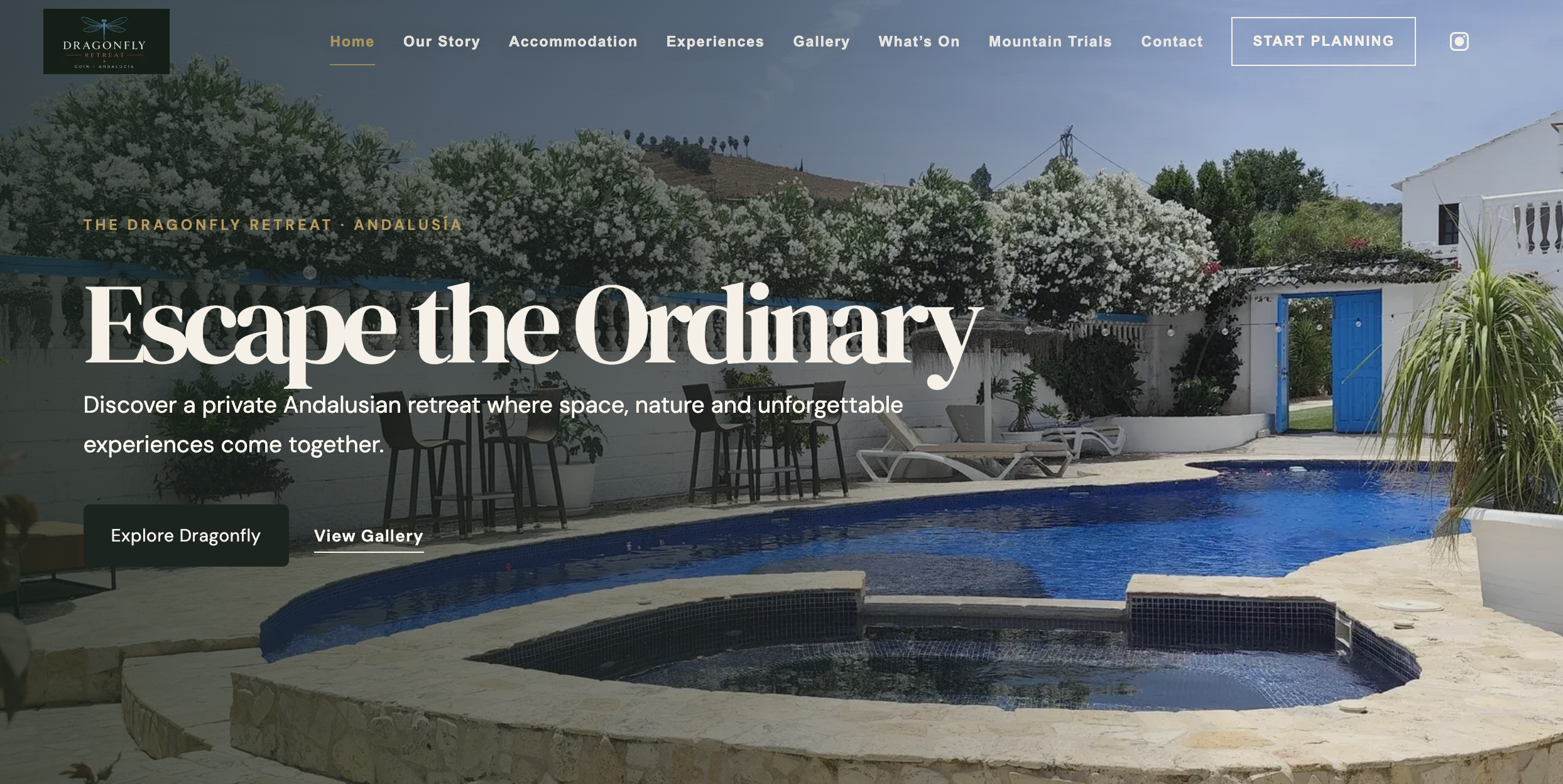
The Dragonfly Retreat is a private, independently created venue in the Andalusian countryside near Coín, in the hills inland from Málaga. It is not a hotel. Groups stay together with gardens, a swimming pool, terraces and indoor and outdoor communal spaces, which gives a facilitator plenty of room to move a session from a shaded terrace to a quiet indoor space as the day changes. Many groups combine mindful moments with the creative, culinary and cultural experiences we host, and our guide to small group retreat games and our article on corporate retreat team-building activities show how lighter activities can sit beside quieter ones.
If you are leading a yoga or wellbeing group, our yoga retreat planning guide for Málaga and Andalucía covers the practical side in more detail.
Hosting a group retreat at The Dragonfly
We welcome retreat leaders, corporate teams, creative groups, families and friends, for adults and young people aged 14 and over. Stays are built around your group: private bedrooms, shared spaces, hosted experiences and meals planned with you. Our current published experiences include Creative Arts – Paint the Landscape, from 995 EUR per person, and Cooking, Food, Wine & Mediterranean Living, from 1095 EUR per person. If you would like to bring your own wellbeing programme, Plan Your Own Group Experience is the place to start, and you can see the rooms and cottages before you decide.
If a quiet, characterful countryside base near Málaga sounds right for your group, we would be glad to talk through dates, group size and the kind of days you have in mind. You can start from our home page and tell us what you are planning.
FAQ
How long should a group mindfulness session be?
For beginners or a busy team, 30 to 45 minutes with one or two short practices is plenty. Established groups often meet for longer, and Plum Village UK suggests one and a half to two and a half hours for a full group meeting. Let the energy of the group guide you.
What can I do with a group that is sceptical about mindfulness?
Start with practical, low-key activities such as sound mapping, a five-senses pause or a walk, and avoid spiritual language. Explain what you will do, make everything optional and keep the first practice short. Many sceptics relax once they see nobody is being asked to perform.
Do people have to close their eyes?
No. Invite people to close their eyes or rest their gaze on a spot in front of them, whichever feels comfortable. Some people feel exposed with closed eyes in a group, and offering the choice makes the whole room more at ease.
Can I run group mindfulness activities without training?
Yes, for simple shared pauses such as breathing, walking, sound mapping and gratitude rounds. Keep your language plain, make everything optional and do not present the session as treatment. For longer courses or work with people who may be vulnerable, look for a qualified mindfulness teacher.
Sources
- What is mindfulness? NHS Every Mind Matters
- 15 Mindfulness Group Activities For Adults, Thrive
- Stilling exercise, Oxford Diocese
- Start a Group, Plum Village UK
- Mindfulness-Based Interventions: Teaching Assessment Criteria, Bangor University
- Educator’s Guide to Mindfulness Activities for Adults, University of Maryland Extension
- MBCT Implementation Resources, East London NHS Foundation Trust
- 10 Scripts for Leading Group Meditations, MindfulnessExercises.com
- Mindfulness-Based Stress Reduction agenda, Mind Remake Project
- Bedriftsretreat i Madrid: Et konkret eksempel