
DRAGONFLY JOURNAL
Mediterranean Menu Ideas for Retreats and Group Stays
Mediterranean Menu Ideas for Retreats and Group Stays

The best Mediterranean menu for a group is built around sharing: a few colourful dishes that can be prepared ahead, set in the middle of the table and topped up as people help themselves. Plan around variety, one or two dishes that do the heavy lifting and a clear route for every dietary need, and the food will do much of the work of bringing a retreat, team off-site or celebration together. Here is how to put that together, from the first breakfast to the last dessert, with practical notes on preparation and serving for 8, 12 or 20.
We look at this from a countryside venue’s point of view. At The Dragonfly Retreat, our private venue near Coín in the hills above Málaga, shared Mediterranean-style meals form part of the group experience, so the questions below are ones we think about when a group asks what dinner will actually look like.
TL;DR
- Build the menu around sharing: mezze, two salads, a grain, one showpiece main, a vegetarian dish that is a main in its own right, bread and a dessert made ahead.
- Choose dishes that hold well: moussaka, tagines, marinated meats and dips can be made a day ahead or earlier, which leaves the cook free to sit down with the group.
- Let guests assemble their own plates (wraps, platters, build-your-own bowls) and dietary needs mostly look after themselves.
- Keep chilled dishes at 8°C or below, and do not leave ready-to-eat buffet food out for more than four hours.
- Treat the menu as a guide, not a rule: what is served depends on the season, the group and the kitchen.
Table of Contents
- Start with the shape of the meal, not the recipes
- Simple breakfasts that keep a group moving
- Colourful lunches that don’t make anyone sleepy
- Sharing platters and buffet ideas
- Grilled dishes and one showpiece main
- Seafood for the evening
- Vegetarian and vegan dishes that are mains in their own right
- Tapas-style food for the evening
- Seasonal desserts
- Preparation: working backwards from the table
- A sample three-day plan for a group of 12
- Where the food fits in a retreat
- FAQ
- Sources
Start with the shape of the meal, not the recipes
Most menu planning goes wrong when people choose dishes one by one. A better approach is to decide the shape of the table first, then fill it. One menu-planning guide for hosts proposes a shared-table structure that works well for groups: mezze to start, two salads, a grain, a showpiece main, a vegetarian backup, a vegetable side, bread and a dessert that can be made ahead.
That structure does three useful things:
- It guarantees variety of colour, texture and temperature without a long list of dishes.
- It gives you one hero dish to build the evening around, so the rest can stay simple.
- It makes the vegetarian guests part of the meal rather than an afterthought.
Mediterranean food is not one cuisine, and it is worth saying so on the menu. Andalucía, Greece, Lebanon, southern Italy and Morocco all have their own habits. You can mix them (a Greek-style mezze followed by a Spanish grill, say), but a menu that follows one thread through the whole stay tends to feel more considered. Think of it as a theme, not a rulebook.
Simple breakfasts that keep a group moving
Breakfast on a retreat should be easy to graze, because people wake at different times and some are up for a swim before anyone else has found the coffee.
- A fruit and yoghurt table: bowls of thick yoghurt, honey, chopped seasonal fruit, nuts and seeds. Guests build their own.
- Tomato and olive oil toast: grated ripe tomato on toasted country bread with good olive oil and a little salt is a classic southern Spanish start, quick to set out for any number.
- Eggs, simply done: a large tray of baked eggs with peppers and tomatoes, or a tortilla cut into squares, holds well on the table.
- Something sweet and light: a plain cake, pastries or figs with cheese for those who prefer it.
- Good coffee, tea and juice: freshly squeezed orange juice makes the table feel like a holiday.
The principle is to put out components rather than plated meals. It copes with early risers, late arrivals and different diets without extra work.
Colourful lunches that don’t make anyone sleepy
Lunch in a warm climate should be fresh, abundant and not too heavy, especially if there is an afternoon workshop, a swim or a walk to follow.
Salads as the centre. Put out two or three: a tomato, cucumber, red onion, olive and feta salad with oregano and olive oil, a bean or chickpea salad with herbs, and something grainy such as couscous. A roasted vegetable and couscous salad from Good Food serves four and the recipe itself suggests doubling it for a buffet, which makes it a dependable base for a larger table.

Something warm and simple. Grilled halloumi, roasted peppers, flatbreads warmed on the grill or a tray of herby roasted potatoes give the table a hot element without anyone standing over a stove.
Dips and bread. Hummus, a smoky aubergine dip, tzatziki and a tomato salsa with plenty of bread cover the table and carry on being useful at dinner.
Sharing platters and buffet ideas
A sharing board is the quickest way to make a group meal feel generous. One Greek-style sharing board recipe for six to eight people combines lamb gyros, aubergine dip, tomato keftedes (tomato fritters), saganaki (fried cheese), warmed pittas, mint, dips and mezze. It is a good model even if you change the contents.
What makes it work for groups is the preparation. The recipe notes that the lamb can marinate for a few hours or overnight, and the aubergine dip and keftedes batter can be made a few hours ahead. Cooked keftedes can be reheated in an oven or air fryer just before serving. In other words, most of the work is done before anyone is hungry.
Some practical rules for buffet-style serving:
- Use several smaller platters instead of one huge one. They are easier to pass, easier to refill and keep the food looking fresh. A hot nibble such as feta filo turnovers can be served on a platter that is replenished as guests arrive, according to Jamie Oliver’s 2023 dinner-party guide.
- Mix heights and colours. Bowls, boards and plates at different levels make the table easier to reach and more inviting.
- Label everything. Small cards saying what each dish is, and whether it is vegetarian, vegan or contains nuts, save the same question being asked fifteen times.
- Put the cutlery and plates at the start of the line, and the napkins at the end, so no one is balancing.
If you want more inspiration on how other Mediterranean-style tables are set for guests, these Mediterranean dining ideas are a pleasant read on keeping food relaxed and informal.
Grilled dishes and one showpiece main
Every good group menu has a moment when the main arrives and people lean in. It does not have to be complicated.
- Grilled meats and vegetables: marinated chicken thighs, lamb chops or skewers with grilled courgettes, peppers and aubergines. Marinating overnight is easy and gives the flavour time to develop.
- Lamb meatballs with tzatziki: Jamie Oliver’s guide says they take 25 minutes and can be prepped in the morning by making the tzatziki and shaping the meatballs, then refrigerating them until cooking.
- Moussaka: one of the best make-ahead crowd dishes. Good Food’s next-level moussaka serves six, takes 40 minutes to prepare and two hours to cook, and once assembled keeps chilled for two days. Serve it with a sharp salad, such as the fennel salad with feta dressing that BBC Food pairs with its moussaka.
- Paella: the great communal dish of southern Spain, cooked once and shared from the pan. If you are curious about the different styles, our guide to paella types explains how they differ.
Whichever you choose, a group of 12 or more usually needs the recipe multiplied, not just one more dish. Increase tray numbers rather than overfilling one: a smoky aubergine and pepper tagine serves four and can be doubled by using a second roasting tin so the ingredients cook evenly.
Seafood for the evening
Seafood says “holiday” more clearly than almost anything else, and it can be simple.
- Prawns with garlic and olive oil, served sizzling in small dishes.
- Grilled sardines or white fish with lemon and herbs.
- A seafood rice or a seafood pasta. Jamie Oliver’s 2023 guide describes a five-ingredient prawn pasta that takes 22 minutes, can be scaled up and lets the prawns marinate in the fridge before guests arrive.
- Mussels or clams steamed with wine and parsley, with bread for the juices.
Seafood is the one category that needs real timing. Cook it close to serving, keep it chilled until then, and have the rest of the table ready first so nothing waits on the grill. It is also worth finding out about shellfish allergies in advance, as they are common enough to affect a group menu.
Vegetarian and vegan dishes that are mains in their own right
A Mediterranean table is naturally generous to vegetarians, since so much of it is built on vegetables, pulses, grains and olive oil. The trick is to make the vegetarian option a dish people would choose, not a plate of whatever is left.
- Tofu gyros: BBC Food’s version serves four to six, is vegetarian, egg-free and nut-free, and sets out tofu, flatbreads and optional toppings for everyone to help themselves. Because the filling is separate from the toppings, guests build wraps to suit themselves.
- Mediterranean vegetable pav bhaji: BBC Food’s recipe serves six to eight, is vegetarian, egg-free and nut-free, and is described as a sharing meal suited to batch cooking. The cooked vegetable base can be frozen for up to three months, with garnishes made fresh for serving.
- Tagine, stuffed peppers, bean stews and roasted vegetable trays: all naturally plant-based with the right fat and stock.
- Tapas: many Spanish small plates are vegetarian already. Our list of make-ahead vegetarian tapas is a good place to start.
Handling dietary needs
Ask for dietary requirements when people book, not on the day. Collect them in one place, ask specifically about allergies as well as preferences, and ask whether the allergy is serious or a dislike, since that changes how carefully dishes must be kept apart. Then:
- Make most of the table vegetarian, so that the meat is the addition and not the main event.
- Keep sauces and dressings separate where you can, so that guests control them.
- Label dishes clearly, including common allergens such as nuts, gluten, dairy, eggs and shellfish.
- Use serving spoons for every dish to avoid cross-contact.
For anyone with a medical allergy, the person with the allergy and the person preparing the food should talk directly before the meal.
Tapas-style food for the evening
A tapas-style dinner suits groups because it removes the pressure of a formal sit-down. People move around, taste a bit of everything and talk.
A balanced evening spread might include:
- Marcona almonds, olives and good cheese on arrival.
- Tortilla de patatas cut into squares.
- Patatas bravas or roast potatoes with a spicy tomato sauce.
- Padrón peppers blistered in olive oil and sprinkled with salt.
- Croquetas or filo turnovers.
- Grilled prawns or a plate of cured meats.
- A simple salad with a sharp dressing to cut through the richness.
Aim for about six to eight dishes for a group, in two or three waves, hot dishes between cold ones. If you are planning a celebration, the same format works for a standing party, with food brought out gradually.
If wine is part of the evening, the right pairings and a few games can make it a talking point; see our ideas for wine tasting games. For those who prefer not to drink, our guide to non-alcoholic Spanish drinks makes sure no one is left with a glass of water.
Seasonal desserts
Keep dessert light and mostly made ahead.
- Spring and summer: sliced peaches, melon, figs or strawberries with honey and yoghurt, or an orange and almond cake. Citrus sorbet works well after a rich meal.
- Autumn: baked figs or pears with honey and nuts, a plum or apple tart, grapes with cheese.
- Winter: oranges with cinnamon, a rice pudding, or a dense chocolate and olive oil cake.
- Any time: a platter of small sweet things, such as fruit, a few biscuits and some dark chocolate, lets people choose a little or a lot.
A cake, a set cream or a fruit salad can be finished the day before, which frees the cook on the day itself.
Preparation: working backwards from the table
The real skill in group catering is the timeline. A few habits help.
- Make-ahead first. Pick dishes that improve or hold well: moussaka, tagines, dips, marinated meats, braised vegetables and cakes. Good Food’s tagine can be frozen for up to three months; defrost it in the fridge overnight and reheat until piping hot.
- Prepare in batches. Large batches of the same dish are often easier than many different small ones. A Good Food guide to popular pasta dishes notes that most crowd-feeding recipes can be made in large batches and that some can be frozen.
- Limit last-minute cooking to one or two dishes. Grilled fish or fresh flatbreads are worth the effort; five of them is not.
- Write a simple timeline. List what is done the day before, what happens in the morning, what goes on an hour before, and what is served last.
- Keep the menu variable. Ingredients differ by season and supplier, so write menus as ideas, not promises.
Food safety at a buffet
A relaxed table is still a food-safety job. Runnymede Borough Council’s chilled storage guidance says chilled food must be kept at 8°C or below, and recommends a fridge or display unit at 5°C or below. It adds that ready-to-eat foods such as salads should stay refrigerated until buffet service and may be left out once for up to four hours, after which they should be returned to the fridge or thrown away.

In practice: bring dishes out in stages, keep a second tray in the fridge to swap in, and keep dips, yoghurt sauces, seafood and cooked rice cold until needed. That’s also a good argument for several smaller platters.
A sample three-day plan for a group of 12
Use this as a starting point and adjust it to your group, season and kitchen.
| Meal | Day one | Day two | Day three |
|---|---|---|---|
| Breakfast | Fruit, yoghurt and honey table | Tomato and olive oil toast, tortilla | Baked eggs with peppers, pastries |
| Lunch | Two salads, hummus, flatbreads | Grilled halloumi, roasted vegetables, couscous | Leftover-friendly platter of dips, cheeses and breads |
| Dinner | Sharing board with lamb, dips and keftedes | Paella evening | Tapas-style supper with seafood |
| Dessert | Fruit with honey and yoghurt | Citrus cake | Seasonal fruit and dark chocolate |
The pattern is deliberate: a lighter lunch before a heavier dinner, one communal showpiece per day and plenty of cold dishes that can be prepared in advance.
Where the food fits in a retreat
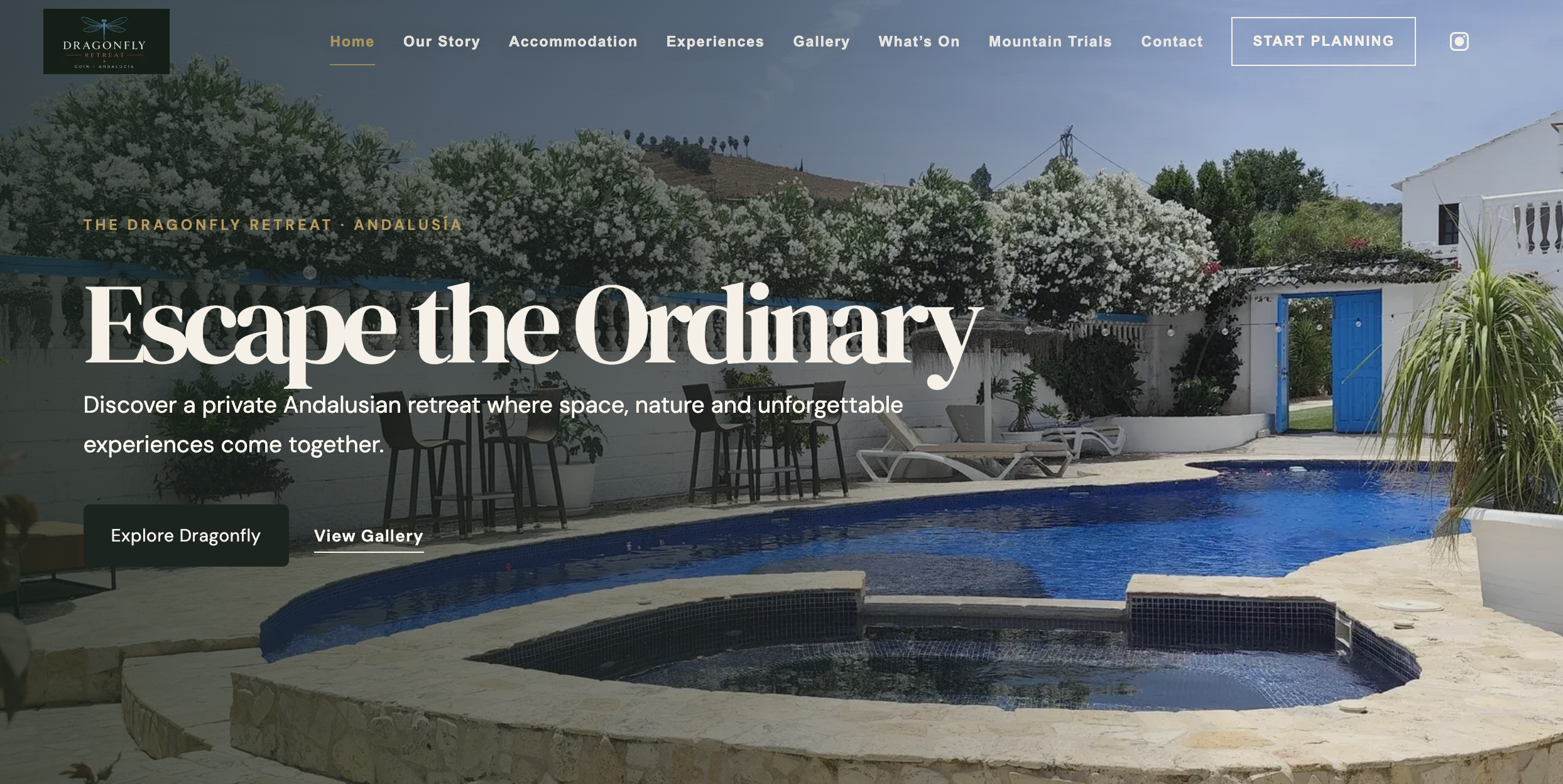
Food is rarely just fuel on a group stay. It is where people sit down together, talk and remember the week. That is why we think a countryside venue works so well for it. At The Dragonfly Retreat, near Coín in the Andalusian countryside, groups stay together with gardens, a pool and indoor and outdoor communal spaces, and meals such as paella evenings and Mediterranean-style dining can be part of the experience.
Our Cooking, Food, Wine & Mediterranean Living experience starts from 1,095 € per person. If you are planning something different, such as a creative week or a celebration, you can plan your own group experience and we shape meals around your group. For organisers thinking about the practicalities, our notes on planning a Málaga retreat with a private chef and cooking team-building ideas may help.
FAQ
How many dishes do I need for a Mediterranean buffet?
For a group of around 12, aim for two or three salads, two or three dips, one or two hot mains, a vegetarian dish, bread and one dessert. Variety matters more than quantity. Smaller portions of more dishes make a table feel generous without much waste.
What can I prepare ahead for a group?
Dips, marinated meats, tagines, moussaka and cakes all work well. Moussaka keeps chilled for two days once assembled, and a tagine can be frozen. Leave grilling, seafood and warming flatbreads to the last minute.
How do I cater for vegetarians and allergies without separate meals?
Make most of the table vegetarian and let guests assemble their own plates, for example with wraps and toppings. Ask about allergies at booking, label every dish and use separate serving spoons. Anyone with a serious allergy should speak directly to whoever is cooking.
How long can buffet food stay out?
Guidance from Runnymede Borough Council says ready-to-eat foods such as salads may be left out once for up to four hours, and chilled food should be kept at 8°C or below. Bring dishes out in stages and keep a spare tray in the fridge.
Sources
- The Gourmet Host: 9 Mediterranean dinner party menu ideas
- Sainsbury’s Magazine: Greek-style sharing board
- Jamie Oliver: dinner party menu with 5 ingredient recipes
- Good Food: roasted veg and couscous salad
- Good Food: next-level moussaka
- BBC Food: moussaka with fennel salad
- Good Food: smoky aubergine and pepper tagine
- BBC Food: tofu gyros
- BBC Food: Mediterranean veg pav bhaji
- Good Food: top 10 most popular pasta recipes
- Runnymede Borough Council: chilled storage and cooling
- Mediterranean dining ideas