
DRAGONFLY JOURNAL
Olive Oil Tasting Guide: How to Run a Tasting for Your Group
Olive Oil Tasting Guide: How to Run a Tasting for Your Group
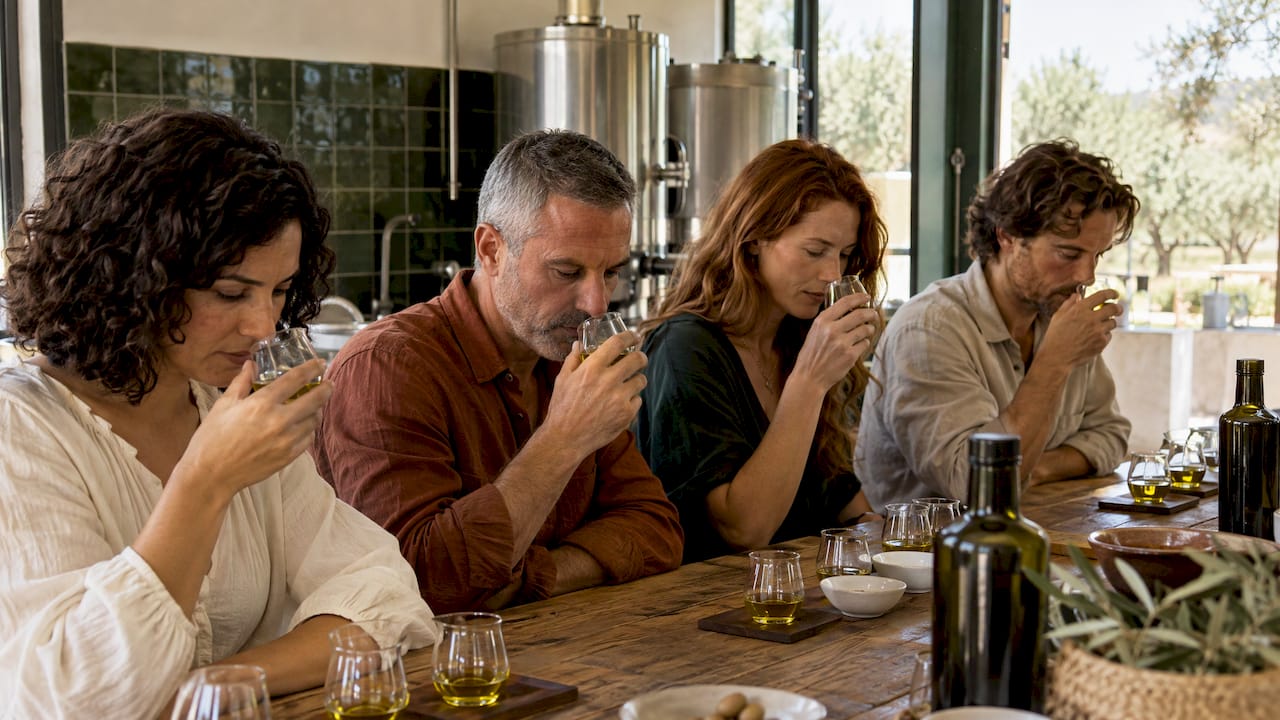
Tasting olive oil properly takes a small glass, a warm hand and about ten minutes: you warm the oil, smell it, take a small sip, and judge three things, fruitiness, bitterness and pungency. Done with a group, it becomes one of the most absorbing sessions you can build into a retreat, a team off-site or a celebration in southern Spain. At The Dragonfly Retreat, near Coín and Málaga, food and Mediterranean living sit at the heart of our hosted group stays, and an oil tasting fits naturally into that kind of week.
This guide gives you the method, the vocabulary and a way of running it for a group of ten or twenty people who have never done it before.
TL;DR
- Pour about 15 ml of oil into a small glass, cover it, warm it in your hand to roughly 28°C, then smell, sip and swallow.
- Judge three positive attributes: fruity, bitter and pungent. A good extra virgin oil is expected to show bitterness and a peppery throat kick.
- Taste three to five oils, mild to strong, and cleanse your palate with green apple and water between them.
- Harvest in Andalucía generally runs from mid-October to December, so autumn and early winter are the natural moment for an olive oil session.
- For a group, give each person a tasting card with a short list of descriptors and taste before bread.
Table of Contents
- Why taste olive oil like a professional
- What you need
- How to taste olive oil, step by step
- What to look for: three positives and a few faults
- Words to describe olive oil
- Building a flight of oils for a group
- Olive oil tasting in Andalucía
- Making it part of a group stay near Málaga
- Common mistakes
- FAQ
- Sources
Why taste olive oil like a professional
Most of us use olive oil as an ingredient. Tasting it as a drink in its own right shows you why two bottles labelled “extra virgin” can taste completely different: one grassy and sharp, another soft and almondy. That difference comes down to the olive variety, how ripe the fruit was when picked and how the oil was handled afterwards.
The Olive Wellness Institute explains that variety has the biggest influence on flavour, and that unripe olives give more pungency, bitterness and green flavours, while ripe olives give milder, buttery, riper-fruit notes.
For a group, that makes olive oil an unusually good tasting subject. It is cheap, needs no special equipment, suits non-drinkers, and gives everyone something to say within minutes.
What you need
- Small clear or dark glasses, one per person per oil. Professionals use dark glasses so colour does not influence judgement; the Estepa designation of origin explains that standardised dark cups are used for exactly that reason.
- A saucer, small plate or watch glass to cover each glass.
- About 15 ml of each oil per person.
- Green apple, still or sparkling water, and plain unsalted crackers or bread for later.
- A quiet room without strong smells. The Oli de Mallorca tasting guide suggests a room at around 20 to 22°C with soft lighting, and avoiding smoking, strongly flavoured or spicy food, coffee or liqueur for at least two hours beforehand. It also prefers mornings, between 10am and 12pm.
Avoid perfume and aftershave on the day. Scent in the room competes with the oil.
How to taste olive oil, step by step
The sequence below follows the step-by-step guide from the Estepa designation of origin, a Spanish oil-producing body.
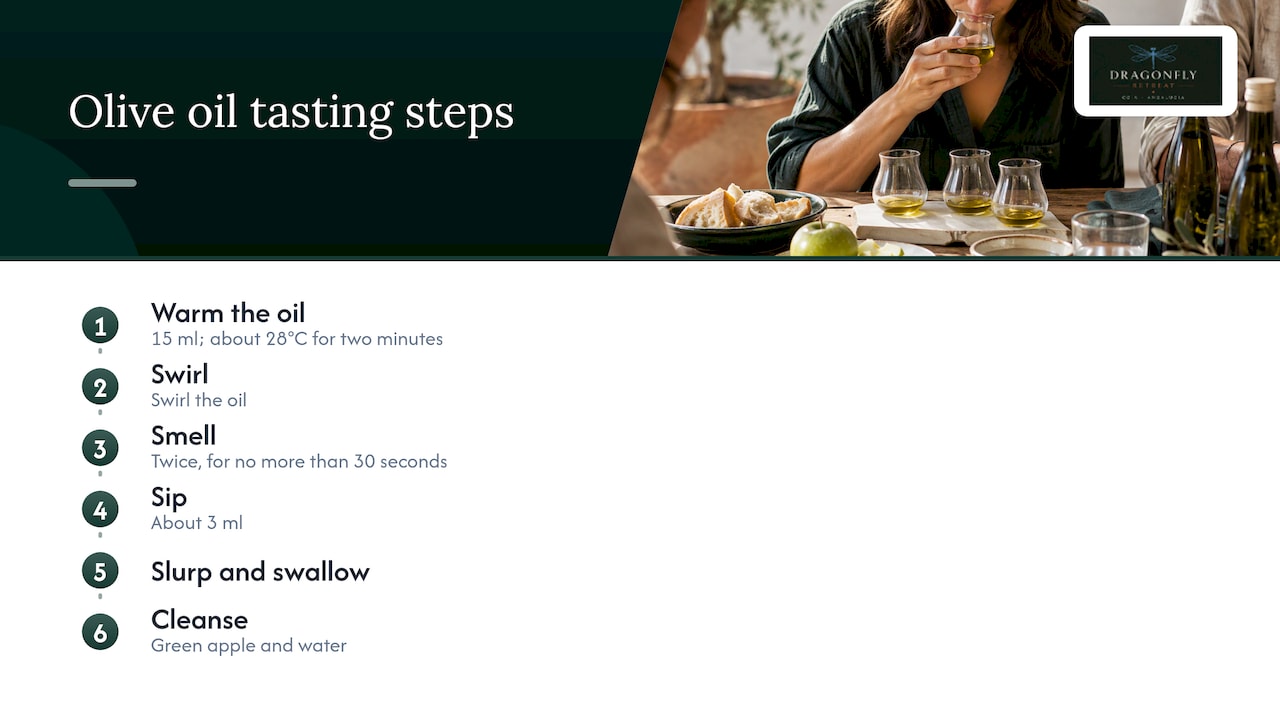
1. Warm the oil
Pour roughly 15 ml into the glass, cover it, and cup the base in your palm for about two minutes. You are aiming for around 28°C. The California Olive Oil Council gives the same target, about 82°F. Warmth releases the aromas that cold oil keeps hidden.
2. Swirl
Tilt and rotate the glass so the oil coats the walls. This increases the surface from which the smell rises.
3. Smell twice
Uncover and smell straight away for a general impression. Cover, swirl again and smell a second time to pick out individual notes. Short, deep sniffs work better than one long inhalation. The official method for professional panels keeps each smelling to no more than 30 seconds, so do not linger.
4. Sip and spread
Take a sip of about 3 ml and move it around the whole mouth: the front of the tongue, along the sides, to the back of the palate. The Priego de Córdoba designation describes where each sensation lands: sweetness at the entrance, bitterness at the back of the mouth and pungency at the end of the throat.
5. Slurp, then swallow
Draw in a little air through your lips while the oil is in your mouth. This spreads the aromas towards the back of the nose. Then swallow. Pungency shows in the throat, and a tickle or cough is a good sign. The California Olive Oil Council calls this part of its “4 S’s”: swirl, sniff, slurp, swallow.
6. Cleanse before the next oil
Bite a slice of green apple, ideally Granny Smith, and follow with water. The California Olive Oil Council recommends exactly this between samples.
What to look for: three positives and a few faults
The North American Olive Oil Association sets out the three positive attributes:
- Fruity: the aroma and taste of the olive itself, fresh, green or ripe.
- Bitter: felt on the tongue, especially at the sides and back.
- Pungent: a peppery bite, strongest in the throat.
To be sold as extra virgin, an oil must have no defects and a fruitiness above zero. The EU classification rules put it in those terms: a median defect score of 0 and a median fruity score above 0.
Bitterness and pungency are not flaws. Estepa’s oil school describes them as markers of quality, because they point to polyphenols, and the Olive Wellness Institute links pungency to the compound oleocanthal: the more polyphenols, the more pungent the oil. This is worth saying to a group at the start, because first-time tasters often assume a peppery cough means something is wrong.
The common faults
The Olive Wellness Institute lists the main defects and what they smell like:
| Fault | What it smells like |
|---|---|
| Rancid | Stale walnuts, old butter, wax crayons |
| Fusty | Mushy brined olives, olive paste left to sit |
| Musty | Wet carpet, mouldy hay, sweaty socks |
| Winey or vinegary | Fermented apple, cider vinegar, nail polish |
If your oil smells like crayons or candle wax, it has gone rancid. America’s Test Kitchen makes the same point and adds that the acidity figure on a label measures free fatty acids, not how bitter the oil tastes.
Words to describe olive oil
Tasting notes are where groups come alive, because people need a shared vocabulary. The Oli de Mallorca guide gives useful reference descriptors:
- Fruitiness: fresh olive, apple, banana, citrus, raw almond.
- Green notes: cut grass, herbs, flowers.
- Bitterness: coffee, tonic water, chicory, green persimmon.
- Spiciness: radish, black or white pepper.
- Sweetness: the mildness of oil from very ripe olives.
For Spanish varieties, Sarah and Olive describe Picual, the most widely grown in Spain and especially in Jaén, as intensely green, with tomato leaf, cut grass and artichoke notes, a satisfying bitterness and a peppery finish. Arbequina, associated with Catalonia, is softer and fruitier, with ripe apple, banana or almond and restrained bitterness.
The Oli de Mallorca guide adds that Mallorquina gives mildness and ripe almond, while Picual gives spicy, bitter oils. Hojiblanca is the third most cultivated variety in Spain, according to Origen Oliva, and it ripens late, so it is harvested from late November to late December.
Intensity labels
If a bottle says “intense”, “medium” or “light”, the EU rules define them by the median fruitiness score: intense above 6, medium from 3 to 6, light below 3. That is a handy way to choose contrasting oils for a flight.
Building a flight of oils for a group
A flight is simply a set of oils tasted in order. The International Olive Council’s guide to tasting for pleasure recommends three to five extra virgin oils that differ by variety, origin, flavour and harvest period, including an intense early-harvest oil and a delicate later-harvest one.
A practical plan for a group:
- Choose three or four oils. Include one soft, ripe-style oil, one medium and one green, peppery early-harvest oil. Early-harvest oil comes from green or just-turning olives and, according to Sarah and Olive, needs 8 to 11 kg of olives per litre against as little as 4 kg for later-harvest oil, which helps explain the price gap.
- Taste from mild to strong. A powerful oil first will flatten the next one.
- Cap it at four samples. The official method evaluates at most four samples per session to avoid sensory fatigue, and a relaxed group tasting benefits from the same limit.
- Taste neat before bread. Bread hides both faults and subtle flavours, so save it for after the scoring round.
- Label glasses with numbers, not names. Blind tasting stops brand and price biases. Professional panels such as Aceite de Navarra’s always taste blind.
- Hand out a simple card. Three lines per oil: fruity, bitter, pungent, each scored from one to five, plus space for a word or two.
A group is not a trained panel, and that is fine. Aceite de Navarra describes its official panel’s analysis as purely technical, far from the descriptive notes written for consumers. A consumer-style session is meant to be enjoyable and conversational, so let people argue about whether that note is artichoke or cut grass.
Olive oil tasting in Andalucía
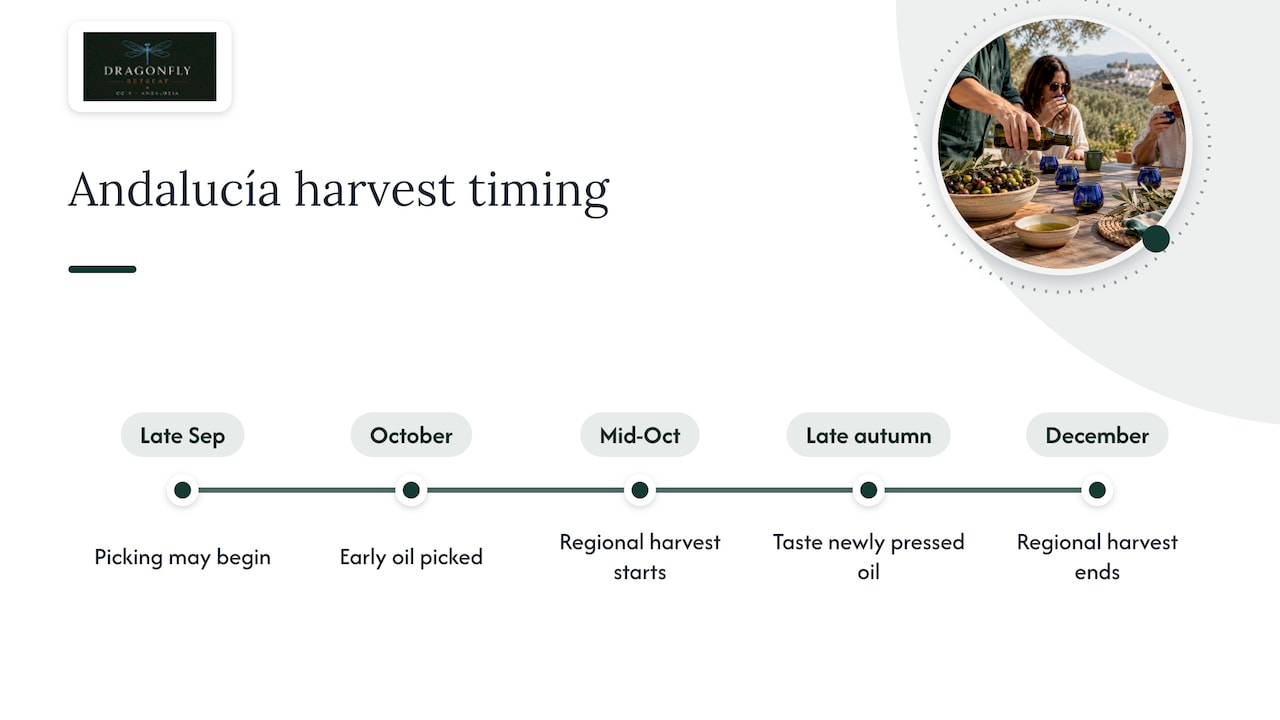
Andalucía produces a large share of Spain’s oil. Jaén alone accounts for around 40% of Spain’s output, according to Olivarte, and the harvest in Andalucía runs from mid-October to December, with early-harvest oil picked in October. Sarah and Olive note that picking in southern Spain can begin as early as the end of September. Timing shifts from year to year with weather and variety, so treat these as typical windows rather than fixed dates.
That makes late autumn and early winter the best time to taste newly pressed oil. When you buy, look for the harvest year on the label: a best-before date is not the same thing, and the harvest year is the more useful guide.
If you are planning a group trip around it, the practical questions are less about the tasting and more about where everyone stays, eats and spends the rest of the day. That is where a private venue helps.
Making it part of a group stay near Málaga
An oil tasting works best as one piece of a longer, food-led programme. Our Cooking, Food, Wine & Mediterranean Living experiences, from €1,095 per person, bring together Mediterranean food, paella evenings and wine tasting in the Andalusian countryside near Coín. If your group would rather paint, our Creative Arts – Paint the Landscape retreats start from €995 per person, and a tasting makes a good evening session either way.

The Dragonfly is a private, independently created venue with gardens, a pool, terraces and indoor and outdoor communal spaces, so a tasting can happen on the terrace and flow straight into dinner. Groups can also shape their own programme through Plan Your Own Group Experience, with quotes based on group size, dates and chosen activities. Our stays are for adults and young people aged 14 and over.
For menu ideas to serve alongside the oil, see our notes on Mediterranean menu ideas for group stays, and if your group enjoys a tasting format, our wine tasting games for groups adapt well to oil.
Common mistakes
- Tasting cold oil. Straight from a cool kitchen, it smells of very little.
- Starting with bread. It masks the very things you are trying to find.
- Too many oils. Beyond four or five, palates tire and notes blur.
- Mistaking bitterness for a fault. Bitterness and pepper are positives in a good extra virgin oil.
- Strong smells in the room. Perfume, coffee and cooking odours all interfere.
- Judging by label alone. Check the harvest year, and taste before deciding.
FAQ
How do you taste olive oil at home?
Pour about 15 ml into a small glass, cover it and warm it in your hand for a couple of minutes. Swirl, smell, then take a small sip, spread it around your mouth and swallow. Look for fruitiness, bitterness and a peppery throat sensation.
What should good extra virgin olive oil taste like?
It should taste fresh and fruity, with some bitterness on the tongue and a peppery tingle in the throat. America’s Test Kitchen lists apple, artichoke and fresh grass as typical flavours. Oil that smells of crayons, wax or vinegar has a fault.
When is the olive harvest in Spain?
Generally from October to February, with November and December the peak months. In Andalucía it typically runs from mid-October to December, according to Olivarte. Exact timing depends on the variety and the year.
How many oils should you taste in one session?
Three to five is a good range for a consumer tasting, as the International Olive Council’s guide suggests. Professional panels cap a session at four samples to avoid fatigue.
Sources
- How is the tasting of an extra virgin olive oil? Estepa DOP
- Tasting guide, Oli de Mallorca DOP
- Cata sensorial, DOP Priego de Córdoba
- Tasting Extra Virgin Olive Oil, North American Olive Oil Association
- How to Taste, California Olive Oil Council
- Tasting, Aceite de Navarra
- Regulation (EU) No 1348/2013, Annex V
- Guide for hedonistic tasting, International Olive Council
- Virtual Sensory Kit, Olive Wellness Institute
- All About Olive Oil, America’s Test Kitchen
- The Definitive Guide to Extra Virgin Olive Oil, Sarah and Olive
- When are olives harvested? Olivarte
- Hojiblanca, Origen Oliva