DRAGONFLY JOURNAL
Team Offsite Ideas in Spain: Plan a Retreat That Works
Team Offsite Ideas in Spain: Plan a Retreat That Works

The best team offsites in Spain are built around one clear purpose, a small number of well-chosen activities, and a venue that lets the group stay together rather than scatter. For UK teams, southern Spain makes that easy: Málaga is a short flight away, and the Andalusian countryside offers space, food and light that an office meeting room never will. What follows is a practical guide to the ideas worth considering, how to balance work with connection and rest, and what to look for in an exclusive-use venue.
TL;DR
- Decide the purpose first (strategy, bonding, creativity or recovery), then choose activities to serve it, not the other way round.
- One structured activity per half-day is usually enough when the group also has work to do. Protect unstructured time as deliberately as you protect the agenda.
- Food-led and creative sessions suit mixed groups better than anything that depends on fitness or competitive streaks.
- A private, self-contained venue saves the hours lost to transfers and keeps the group together between sessions.
- Spring and autumn are the most dependable seasons for southern Spain; book early if you want a choice of dates.
Table of Contents
- Start with what the offsite is for
- Team offsite ideas that work in Spain
- Balancing productivity, connection and downtime
- How to choose a venue for exclusive use
- One example: The Dragonfly Retreat near Coín
- When to go
- Planning the practicalities
- Planning a team offsite at The Dragonfly
- FAQ
- Sources
Start with what the offsite is for
Most disappointing offsites share a flaw: the programme was assembled from a list of activities, and nobody could say afterwards what it was meant to achieve. Before you look at a single idea, write one sentence that finishes “After these days, the team should…”. Typical answers fall into four groups.
- Decide something. A strategy break, a planning cycle, a leadership reset. You need quiet rooms, good light and long, uninterrupted blocks.
- Connect. A new team, a merged team, a remote team that rarely meets. You need shared tasks and shared meals more than formal sessions.
- Create. A product, brand or culture workshop. You need space to spread out and a change of mode from screens.
- Recover. A reward after a hard year. You need low-pressure days where nobody has to perform.
Most groups want a blend, which is fine, provided you know which purpose wins when the schedule gets tight. That decision is what the rest of the plan hangs on.
Team offsite ideas that work in Spain
The ideas below are grouped by what they do for a team. Mix two or three, not all of them.
Focused work sessions
The reason to leave the office is to think differently, so give real work a proper place in the plan. Morning blocks of two to three hours, with a break built in, tend to work better than a full day of back-to-back sessions. Choose a room with natural light and somewhere outdoors to take the conversation when it stalls. A walk around a garden with a colleague often unlocks what a conference table cannot.

If you want an outside facilitator, brief them on the single outcome you want. A facilitator with a vague brief produces a pleasant day and nothing you can use on Monday.
Facilitated workshops
Workshops are most useful when they end in a decision or a shared document, not a feeling. Keep groups to a size where everyone speaks: tables of four to six work well. Finish each workshop with a short debrief that asks what the team will do differently, and who owns it. Our own piece on team-building ideas and debriefs that stick goes further into how to structure that conversation.
Cooking and food experiences
Cooking is one of the most reliable team activities in Spain, because everyone has a job and the result depends on the whole group. A paella evening is the classic: one person chops, another watches the rice, someone argues about the stock, and then everyone eats what they made. It suits all ages and fitness levels, and it does not rank people by seniority. It also produces the kind of conversation that continues over the meal. We have written separately about cooking team-building ideas for corporate retreats in Andalucía if you want more detail on formats.
Wine tasting sits naturally alongside this. It gives the group something to talk about that is not work, and it can be as informal or as structured as you like.
Creative sessions
Painting, photography or another hands-on craft takes people out of their professional roles. Nobody is the expert, and that levels a room quickly. Andalusian light and landscape make a good subject, and a creative session works well as a gentle half-day after an intense work block. Choose something where the outcome is personal, not a competition, so that quieter colleagues are as comfortable as the extroverts.
Outdoor activities and nature
Walks, guided hikes and time in the countryside give the group shared experience without needing a plan. Match the activity to the least fit person, not the most. In high summer, schedule anything physical for early morning or late afternoon. If you want something more ambitious, southern Spain has plenty, but keep it to one headline outing in the whole stay.
Local excursions
Andalucía’s heritage, from white villages to historic cities, gives you a ready-made day out. The trap is overloading. A full day of coach travel between sights eats the time you came to spend together. One excursion in a three- or four-night stay is usually plenty, ideally with a long lunch in it.
Relaxed group meals
The shared table is where an offsite does much of its quiet work. Long dinners with no agenda let relationships form across departments, and they cost nothing in terms of structure. Plan at least one meal that is deliberately unhosted and unhurried, and resist the urge to schedule a speech.
Unstructured social time
This is the part organisers cut first and attendees remember longest. Pool time, a late coffee on a terrace, a game of cards after dinner: none of it needs organising, but it needs to exist in the timetable and in a place where people naturally bump into one another. A venue with gardens and shared spaces does this far better than a hotel where everyone retreats to their own room.
Balancing productivity, connection and downtime
A useful rule is to give each day one anchor and let the rest breathe. Here is a sample three-night shape for a team of mixed seniority that needs to plan and also bond. It is a model to adapt, not a fixed formula.
| Day | Morning | Afternoon | Evening |
|---|---|---|---|
| Arrival | Travel | Settle in, pool or garden time | Relaxed group dinner |
| Day 1 | Focused work session | Free time | Cooking experience and shared meal |
| Day 2 | Facilitated workshop | Creative session or local excursion | Unhosted dinner, social time |
| Departure | Short debrief and next steps | Travel | n/a |
A few principles keep the balance honest.
- Work in the morning, connect in the evening. Energy and concentration are highest early. Evenings suit conversation.
- One structured activity per half-day. Planners who work on Spanish group programmes commonly suggest this for groups that also have to work, and it matches common sense.
- Leave gaps, then defend them. If a session overruns, shorten the next session, not the free time.
- Think about the quiet people. Offer a mix of formats so that introverts and extroverts each have a place where they shine.
- Plan the follow-up. Agree before you leave who will circulate decisions and by when. Offsites that end without actions fade within a fortnight.
How to choose a venue for exclusive use
The venue shapes everything else, so it deserves more attention than the activity list. For a team offsite, an exclusive-use venue means your group has the property to itself. That changes the experience in practical ways.
Privacy for real conversation. When no other guests are around, you can discuss strategy on the terrace without lowering your voice, and leave materials out between sessions.
A compact footprint. Some planners describe the walkable footprint of a venue as the single most underrated variable: if people have to arrange transport for every meal and activity, the group loses hours each day and most of the unstructured time that makes a retreat worthwhile. Everything on one site, with sleeping, working, eating and relaxing within a short stroll, removes that friction.
Variety of spaces. Look for both indoor and outdoor communal areas, so you can switch between a focused session and a relaxed one without moving the group anywhere.
Accommodation that suits the group. Ask how the rooms are arranged and whether they are private bedrooms. Teams that spend all day together appreciate somewhere to retreat to at night.
Food handled for you. If meals are planned with the venue, nobody on your team spends the offsite organising lunch.
A host who understands groups. The difference between a venue and a well-run venue is someone who can shape the stay around your goals, not just hand over keys.
We go through this decision in more detail in our guides to choosing a group retreat venue near Málaga and why an exclusive retreat beats apartments for group stays.
One example: The Dragonfly Retreat near Coín
The Dragonfly Retreat is a private retreat and group venue in the Andalusian countryside near Coín, in the Málaga area. It is independently created and is not a conventional hotel or resort. A group can stay together with private bedrooms, gardens, a swimming pool, terraces, and indoor and outdoor communal spaces. Accommodation includes the Pearl Suite, Wisdom Room, Starburst Cottage and Starlight Rooms, which you can see on the accommodation page.
The stays are hosted and can include Mediterranean food, paella evenings, wine tasting, art, photography, nature activities and excursions around Andalucía, with itineraries and meals planned around the group. The venue welcomes adults and young people aged 14 and over, and has a peaceful, adult-oriented atmosphere. That combination of a single site, shared spaces and planned hospitality is the kind of setup the previous section describes.
When to go
Southern Spain suits an offsite for much of the year, but the seasons differ. UK planners generally point to spring and autumn as the safest windows, with warm, reliable weather and better availability, while inland cities in summer can pass 35°C. Winter is mild in the south, though days are shorter and some seasonal closures apply.
In practice:
- Spring and autumn: the easiest choice for a balanced agenda with outdoor time.
- Summer: possible, but front-load work into the morning and plan pool time and shade for the afternoon.
- Winter: attractive if you want sunshine when the UK has little, with a programme built around food, culture and indoor sessions.
Our guide to the best time of year for a retreat in Andalucía covers the pattern in more depth.
Planning the practicalities
Lead time. Popular windows fill first. For a smaller group, several months ahead gives you a real choice of dates; for larger groups or anything with flights and external speakers, allow longer. Book early for choice of dates, not necessarily lower prices.
Budget. Costs are driven mainly by season, whether you have exclusive use, how many nights you stay and how complicated the transfers are. Ask for a quote built on your group size, dates and chosen activities, and check exactly what it includes: accommodation, meals, experiences and any extras. For reference, The Dragonfly’s published prices start from €995 per person for Creative Arts, Paint the Landscape, and from €1,095 per person for Cooking, Food, Wine and Mediterranean Living.
Travel. Málaga is the natural gateway for the Costa del Sol and the countryside inland. Agree a single arrival window if you can, so the group is not trickling in over a day.
Accessibility and dietary needs. Collect these early and share them with whoever is planning meals and activities. Check anything physical against the least mobile member of the team.
The wider logistics. For a checklist of programme and hospitality arrangements, this corporate retreat planning guide is a useful companion.

Planning a team offsite at The Dragonfly
If you would like your team to work, eat and unwind in one place in the Andalusian countryside, we can build the stay around you. Options include the Creative Arts and Cooking, Food, Wine and Mediterranean Living experiences, or you can plan your own group experience with an itinerary of your choosing. Quotes are based on group size, dates and the activities you select.
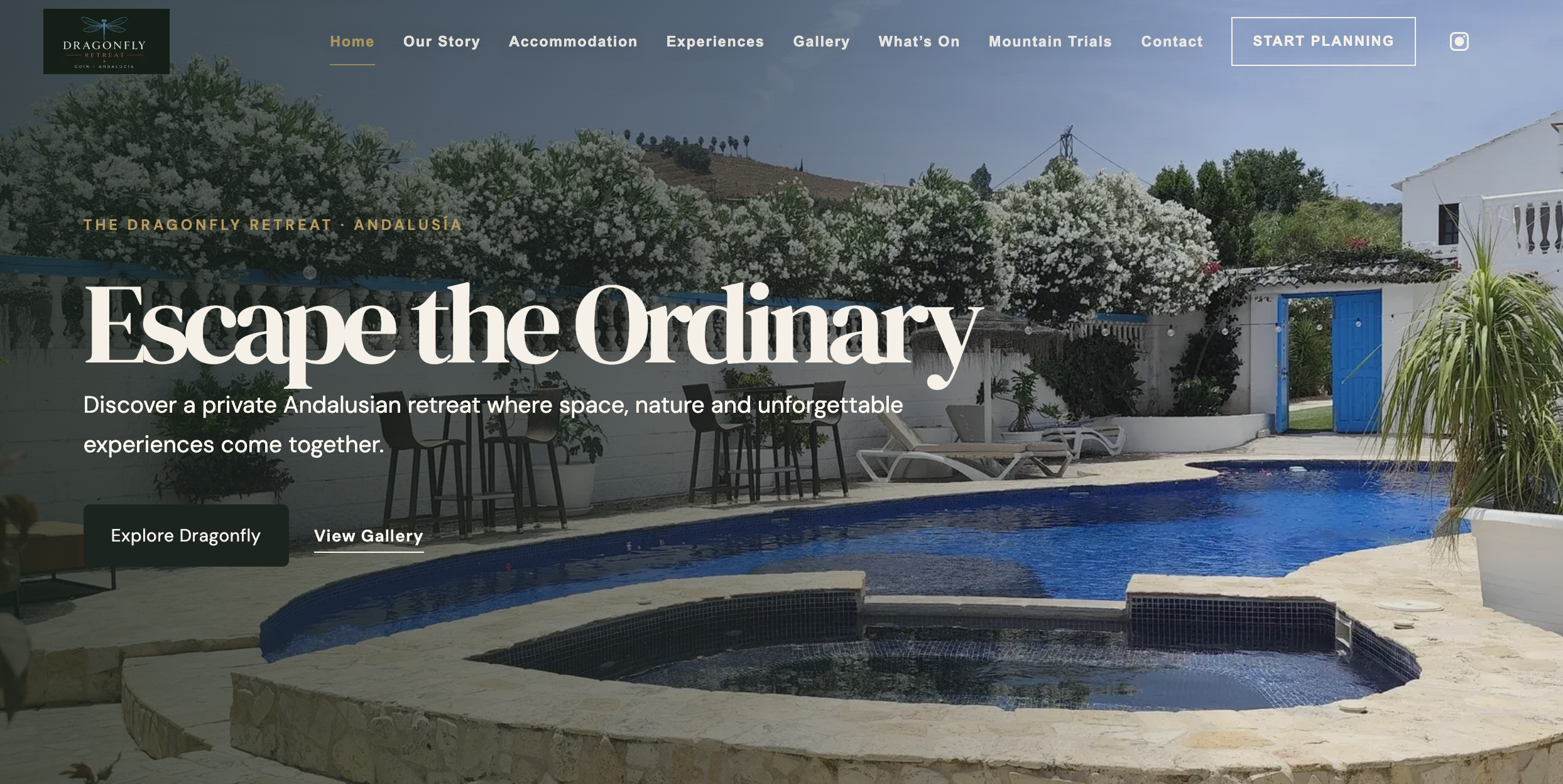
You can also look through life at Dragonfly to get a feel for the place.
FAQ
How long should a team offsite in Spain be?
Two to four nights suits most teams. That allows a travel day at each end and two or three full days of programme. Shorter than that and much of the time goes on logistics; longer and you may struggle to hold attention on a work agenda.
How many activities should we plan?
Fewer than you think. One structured activity per half-day is usually enough if the group also has to work, with the remaining time left for meals, rest and conversation. If in doubt, cut an activity and keep the free time.
What suits a group with mixed fitness and interests?
Food, wine and creative sessions are the safest choices, because anyone can take part. Keep demanding outdoor activities optional, and offer an alternative so that nobody feels left out.
What is the advantage of an exclusive-use venue?
Your team has the property to itself, so you can work and talk openly, move easily between indoor and outdoor spaces, and avoid time lost on transfers. It also makes the whole stay feel like one shared experience.
Can a venue near Málaga cater for both work and celebration?
Yes, many groups combine the two, with working sessions by day and a shared meal or celebration in the evening. At The Dragonfly, Music, Vibes and Celebrations is one of the experiences available for groups.