DRAGONFLY JOURNAL
Wine Tasting Games for Groups, Retreats and Celebrations
Wine Tasting Games for Groups, Retreats and Celebrations

The best wine tasting games for a mixed group are blind tasting, aroma matching, a region or grape challenge, a food-pairing round and a simple scorecard. Pick two or three, keep the pours small, put water and food on the table, and give non-drinkers a proper glass of something interesting. Nobody needs to know anything about wine to play, and the games work just as well at a retreat evening or a birthday weekend as at a dinner party.
Below you will find how each game works, what you need, how long it takes to prepare, and how to keep the evening relaxed for beginners and enthusiasts alike.
TL;DR
- Choose two or three games for one evening rather than cramming in seven. Mix one blind tasting with one lighter, chattier game.
- Disguise bottles with paper bags or foil, label them with letters, and write the key down before guests arrive.
- Pour small (around 50 ml), serve light wines before full ones, and keep water, bread and snacks within reach.
- Make alcohol-free options part of the game, not an afterthought, and never reward speed or quantity.
- A scorecard needs only three headings: look, smell, taste. Add a line for “what I’d eat with this”.
Table of Contents
- Choosing the right game for your group
- Blind tasting: the game everything else is built on
- Aroma guessing
- Grape and region challenges
- Food-pairing games
- Guess the price and wine brackets
- Simple scorecards that anyone can use
- Keeping it relaxed and inclusive
- Pacing, water, food and alcohol-free options
- A sample evening for 10 to 12 guests
- Where this works well: a private countryside setting
- Planning a group stay in southern Spain
- FAQ
- Sources
Choosing the right game for your group
Start with who is in the room. A team of colleagues who barely know each other needs something that gets people talking. A group of friends on a birthday weekend probably wants a bit of friendly rivalry. A retreat group may simply want a slow, sociable evening around a long table.
The numbers matter too. Sommy’s games guide gives rough requirements: Aroma Match suits 2 to 8 players with about 30 minutes of preparation, Region Match needs 3 or 4 wines for 3 to 8 players, Wine Bingo works with 5 or 6 wines for 4 to 12 players, and Wine Brackets needs 8 wines and 8 or more players. Those figures come from one American guide, so treat them as sensible starting points rather than rules.
One piece of advice worth following: Winelingo recommends hosts pick two or three games for a single evening. Any more and the tasting turns into admin.
| Game | Best for | Wines needed | Prep |
|---|---|---|---|
| Blind tasting | Most groups, any size | 4 to 8 | 20 to 30 minutes |
| Aroma match | Small groups, icebreaker | 1 or 2, plus jars | About 30 minutes |
| Region or grape challenge | Mixed knowledge | 3 or 4 | About 10 minutes |
| Wine bingo | Larger, chatty groups | 5 or 6 | About 15 minutes |
| Guess the price | Competitive friends | 1 per guest in Sommy’s version | About 10 minutes |
| Wine brackets | 8 or more players | 8 | About 15 minutes |
| Food-pairing round | Dinner or celebration | 2 to 4, plus food | Depends on the food |
Blind tasting: the game everything else is built on
Blind tasting is the classic. Guests taste wines without seeing the label, say what they think they are drinking, and then find out. It levels the room, because a label cannot impress anyone.
How to set it up
- Choose a theme. Winelingo suggests picking a theme and closely matched wines, for example four white wines from different countries, or three Spanish reds. A tight theme makes guessing fairer.
- Disguise the bottles. The Washington State Wine Commission suggests slipping each bottle into a brown paper bag secured at the neck with a rubber band, then asking a guest who did not watch to shuffle the order. Foil wrapped over the neck does the same job. Remove any capsule that might give the producer away.
- Label and log. Number or letter each bag and write down, in secret, which wine is which. Letters can stop confusion when scores are numbers, so “I gave Wine B a 7” is clearer than “I gave number 4 a 4”.
- Prepare the wines. Chill and open them in advance, as Winelingo advises.
- Pour and taste. Jancis Robinson notes that a typical blind tasting involves six to twelve wines. For a relaxed group, four to six is plenty.
- Write before talking. Ask everyone to jot down impressions first, so the loudest voice does not decide for the table.
- Reveal. Compare guesses, then unmask the bottles one at a time.
Ways to vary it
- Red or white in black glasses. Food & Wine suggests black glasses to hide a wine’s colour for a harder blind tasting. It is surprisingly tricky, and funny when experts get it wrong.
- Describe it in three words. Each guest gives three words per wine. It suits beginners because there is no technical vocabulary to get wrong.
- Rank and reveal. Everyone ranks the wines from favourite to least favourite, then the group discovers whether the cheapest bottle won.
Aroma guessing
Smell is where beginners often surprise themselves. Set out small jars or glasses, each with a single scent: lemon zest, a strawberry, a pinch of black pepper, a sprig of rosemary, a vanilla pod, crushed cherry stones. Guests sniff and guess.

You can play it on its own or link it to a wine. Pour one aromatic wine, such as a Sauvignon Blanc or a Garnacha, and ask which jars match what they can smell. Winelingo lists aroma jars among its party games, and Sommy puts preparation at around half an hour, mostly for gathering the ingredients.
Keep scoring light. One point for each match is enough, and you can award a bonus for the most imaginative description. A guest who says a wine smells of “wet garden after rain” has done the job well.
Grape and region challenges
These suit groups with mixed knowledge because you can pitch the difficulty wherever you like.
Region match. Pour three or four wines from different regions and give guests a list of the places. They match each glass to a region. Spain gives you plenty of material: a Rías Baixas white, a Rioja, a Ribera del Duero, a sherry. Choose wines with clear differences so there are real clues to find.
Wine Options. Sommy describes a game in which everyone stands, tastes the same blind wine and answers either/or questions, such as Old World or New World, then before or after 2015, and a wrong answer means sitting down. The last person standing wins. It is quick and lively, and it works well after dinner. Change “sit down” to “move to the other side of the room” if you prefer to keep everyone involved.
Wine trivia. Teams of at least three, one point per correct answer. Mix wine questions with general ones, such as geography and food, so that non-experts contribute. A kit like Wine Wars exists for this, but a dozen questions written on cards will do.
Food-pairing games
Pairing games shift attention from “is this wine good?” to “what does it go with?”, which is a friendlier question for novices.
Here is a simple format. Offer four small bites: a salty cheese, something sweet like quince paste, a spicy chorizo slice, and a piece of fruit or a plain cracker. Pour one wine and ask guests to try it with each bite, then vote for the best and worst match. Repeat with a second wine and compare. The surprise is usually how much a wine can change from one bite to the next.

If you want to understand why pairings work, this sensory guide to how pairing shapes flavour is a good primer for hosts. For a gentler version of the game, try a “match the snack” round: guests taste a wine blind and choose from three dishes which they would serve with it.
The Telegraph’s Victoria Moore makes a point that supports all of this: tasting wines in pairs is more illuminating than tasting them alone. She recommends two glasses per person, so guests can compare side by side, and letting people discard a pour they do not like.
If you are cooking for the group, our make-ahead vegetarian tapas ideas give you plenty of small plates that suit a pairing round.
Guess the price and wine brackets
Guess the price. Each guest estimates the price of each wine, and the smallest total error wins. Sommy’s version has the smallest total price-guess error winning. Use wines in a modest range and reveal the real prices at the end. The result often makes a good talking point.
Wine brackets. This is a knockout. Wine Folly’s version needs eight themed wines, a master bracket, a bracket for each attendee, paper bags or foil, tasting glasses and pens. Each round pits one wine against another, guests vote, and winners advance until one wine is left. It suits groups of eight or more and gives a clear shape to the evening. With that many wines, keep pours to the minimum, and consider spreading the rounds over a long dinner.
Murder mystery kits. If your group prefers acting to analysing, boxed wine-themed murder mysteries exist. For example, Masters of Mystery’s boxed edition costs £43.99 and suits 4 to 20 players, with gameplay of roughly 1.5 to 3.5 hours. Check the current price on the seller’s page before you buy.
Simple scorecards that anyone can use
A scorecard gives guests something to hold and something to say. Keep it simple. The WSET’s beginner approach to tasting looks at appearance, nose and palate, and on the palate it considers sweetness, acidity, tannin, alcohol and body. That is a very good skeleton for a party card.
Here is a version you can copy onto paper:
| Wine | Look (colour) | Smell (what do you notice?) | Taste (sweet, sharp, soft, grippy?) | Guess (grape or region) | Score out of 10 |
|---|---|---|---|---|---|
| A | |||||
| B | |||||
| C | |||||
| D |
Add one extra line at the bottom: “What would I eat with this?” It gives a natural bridge into a pairing game.
Scoring more seriously
If your group likes a bit more rigour, the Good Housekeeping Institute uses a framework known as BLIC. It looks at balance, length, intensity and complexity. Explain each in a sentence and let guests score each from 1 to 3. Do not over-engineer it: this is a game, and people will disagree. That is the fun of it.
For the game score, award points for correct guesses and, separately, for the group’s favourite wine. That way, the winner of the guessing and the winner of the tasting are not the same competition.
Keeping it relaxed and inclusive
The host’s job is less about expertise than about atmosphere. Sommy’s team says that curation and pacing matter more than knowledge, since the wines do the teaching. They suggest closing your briefing by saying there are no wrong answers, only honest impressions. It is a good line, and it works.
A few practical habits help:
- Seat people deliberately. Jancis Robinson suggests sitting everyone around a single table and placing beginners next to more experienced tasters who can guide them.
- Use teams. Pairs or small teams spread the pressure. A nervous guest can contribute without being the only one to guess.
- Give everyone a role. One person keeps the answer key, one pours, one keeps score. Experts can be the pourers, which keeps them useful without letting them dominate.
- Celebrate odd answers. Award a prize for the most creative tasting note, not just the most accurate.
- Let people pass. Anyone can skip a round or a pour without explanation.
Pacing, water, food and alcohol-free options
A good tasting is slow. Keep it that way, and make it easy for guests to moderate.
Small pours. Winelingo recommends 50 to 75 ml per tasting, so one bottle serves 10 to 15 people. Victoria Moore notes that a bottle gives up to 25 pours at 30 ml, or 15 to 16 at 50 ml. Both are far smaller than a normal glass.
Time. Jancis Robinson says each wine needs five to ten minutes of analysis and ten minutes of discussion, so six wines in two flights of three take about two hours. Plan your evening around that, and leave room for dinner and conversation.

Order. Serve lighter wines before fuller ones, with whites before reds in most themes.
Water and food. Diageo’s hosting guidance advises offering alcohol-free options, keeping water jugs filled and placing plenty of snacks nearby to slow alcohol absorption. It also notes that the body takes about an hour on average to process one standard drink. Put a water glass at every place and plain bread or crackers on every table.
Spit cups. Food & Wine lists a spit cup and a glass of water among the basics for each taster. Say plainly that spitting is normal, and nobody has to finish a pour.
Alcohol-free guests. Do not give non-drinkers a soft drink and a shrug. Let them play every game using alcohol-free alternatives, such as a good alcohol-free sparkling wine, verjuice, cold tea, or sparkling water with fruit and herbs. Aroma games and food-pairing games work with any liquid. For scoring, they can judge flavour and match as everyone else does.
Avoid drinking-game rules. Do not reward speed or quantity, and do not use forfeits that involve drinking more. UK guidance on licensed premises defines drinking games as activities that encourage people to drink a quantity within a time limit, or as much as possible. That guidance applies to licensed venues in England and Wales, but it is a good principle for any host. Tasting games should reward noticing, not drinking.
If you want a broader look at hosting a welcoming tasting, this guide to planning a welcoming wine tasting has practical ideas on pacing guests.
A sample evening for 10 to 12 guests
Here is one way to put it together, with about two and a half hours in total:
- Arrival (20 minutes). Alcohol-free welcome drinks and nibbles. Explain the format and say there are no wrong answers.
- Aroma match (20 minutes). Six jars, in teams of three. A gentle way to start.
- Blind flight of three whites (30 minutes). Small pours, scorecards, then the reveal.
- Supper break (40 minutes). Eat properly. This is the pacing step that matters most.
- Food-pairing round with two reds (30 minutes). Three bites, vote on the best match.
- Awards (10 minutes). Best guess, most creative note, group favourite.
It can be shortened easily: drop the aroma round for a smaller group, or turn the supper break into the pairing round.
Where this works well: a private countryside setting
These games suit a place where people can linger. A private venue with a terrace, a long table and no other guests means the evening can run as slowly as the group likes, and nobody has to rush for a last bus.
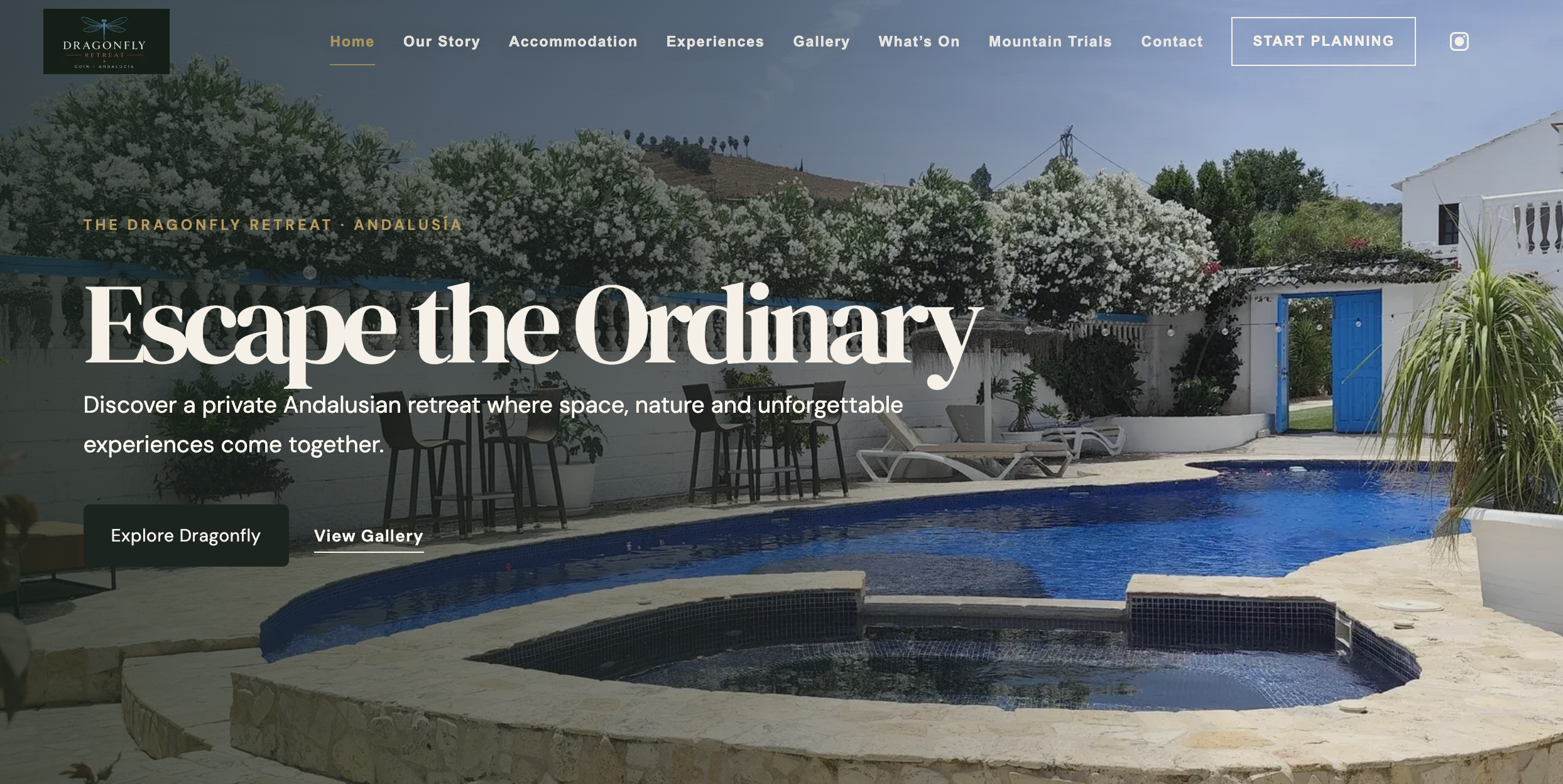
The Dragonfly Retreat is a private retreat and group venue in the Andalusian countryside near Coín, Málaga. It has gardens, a swimming pool, terraces, and indoor and outdoor communal spaces, so a group can move from a pre-dinner game on the terrace to a long supper indoors. We create personalised group experiences that can include Mediterranean food, paella evenings and wine tasting, shaped around the group. Wine tasting is not part of every booking: it is something we can plan with you as part of a bespoke stay.
If you are organising a retreat, our small group retreat games and corporate team-building ideas offer more to build around. Our retreat planning checklist helps with the rest.
Planning a group stay in southern Spain
If you would like an evening like this in the Andalusian countryside, our food, cooking, wine and Mediterranean living retreats start from €1,095 per person. They are hosted group stays built around food, and we shape them to your group.
See the Cooking, Food, Wine & Mediterranean Living retreats for details, or look at the rooms and suites to see where your group would stay. If you have a different occasion in mind, such as a celebration or a creative weekend, the Plan Your Own Group Experience page is the place to start. Quotes depend on group size, dates and the activities you choose.
FAQ
What is the easiest wine tasting game for beginners?
Describe it in three words is the easiest. Guests taste a wine and give three words, with no technical vocabulary needed. Aroma matching with jars is also very approachable, because it relies on everyday smells rather than wine knowledge.
How many wines do I need for a wine tasting game?
Four to six is enough for most groups. Sommy suggests four to six bottles and four to eight guests for a 90-minute tasting at home, while brackets need eight. With 50 ml pours, one bottle goes a long way.
How do I run a wine tasting if some guests do not drink alcohol?
Include them in every game with alcohol-free alternatives in matching glasses. Aroma, pairing and description games work with any drink. Keep water on the table, offer food throughout, and make sure nobody is asked why they are not drinking.
What should a wine tasting scorecard include?
Keep to three headings: look, smell and taste. Add a space for a guess at the grape or region, a score out of 10 and a note on what you would eat with it. More detailed cards can add sweetness, acidity, tannin, body and finish.
Sources
- Wine Tasting Games: 12 Party Games With Rules and Scoring, Sommy
- How to Host a Wine Tasting at Home (+ Games), Winelingo
- How to Host a Wine Tasting at Home: A Practical Guide, Sommy
- How to Host a Blind Tasting Party, Washington State Wine
- Organise your own wine tasting, Jancis Robinson
- How to Host a Label-Free Wine Tasting, Food & Wine
- Wine Brackets: The Ultimate Wine Tasting Game, Wine Folly
- How to host a wine tasting at home, The Telegraph
- Wine Tasting Murder Mystery Game Kit, Masters of Mystery
- An introduction to wine, WSET Level 1 workbook
- How we test and find the best wines, Good Housekeeping Institute
- Embrace the Magic of Moderation, Diageo
- Guidance on Mandatory Licensing Conditions, UK Government
- Why Alcohol Pairing Enhances Dining: A Sensory Guide
- Yacht Wine Tasting in Barcelona: How to Plan One